Key takeaways
- Oversized residential garage doors usually run 10 to 14 feet wide and 12 to 16 feet tall, compared with 8 to 10 feet wide and 7 to 8 feet tall for a standard single door.
- An oversized basic steel door with no insulation costs about $800 to $1,500, while an insulated steel door costs about $1,500 to $3,000.
- Clopay lists R-values up to 18.4 for most of its 2-inch Intellicore insulated doors.
- Steel, aluminum, fiberglass and vinyl doors need little upkeep, but wood doors need regular sealing or painting to prevent warping and rot.
An oversized garage door is a residential door wider or taller than the standard 8 to 10 foot single door, built for large SUVs, trucks, RVs, boats, workshops or extra storage. Below, RJ Garage Door Service in Raleigh covers types, costs, materials, insulation, sizes, upkeep and noise.
Which garage door types come in oversized sizes?
Four garage door types come in oversized sizes: sectional, roll-up, side-hinged and sliding.
- Sectional doors are made of panel sections connected with hinges. When the door opens, the panels bend and slide up along a track. Sectional doors are the most common type on homes.
- Roll-up doors suit garages with limited ceiling space, since the door rolls up into a compact coil above the opening. They are common on commercial buildings but work on homes too.
- Side-hinged doors open like traditional double doors. They suit a carriage-house look.
- Sliding doors move horizontally along a track, much like a sliding barn door. They are less common and need no headroom above the opening.
What is the average cost of an oversized garage door?
An oversized garage door costs roughly $800 to $5,000 before installation, depending on size, material and options:
| Door type | Typical price range |
|---|---|
| Basic steel door (no insulation) | $800 to $1,500 |
| Insulated steel door | $1,500 to $3,000 |
| Wood door | $2,500 to $4,500 |
| Aluminum or fiberglass door | $2,000 to $5,000 |
Budget for installation as well, which typically adds $500 to $1,000 to the total. A Wi-Fi-enabled opener or noise reduction costs more. If you only need a taller opening for a lifted truck, a basic steel door may be all you need.
What material options work for an oversized garage door?
Five material options work for an oversized garage door: steel, wood, aluminum, fiberglass and vinyl.
- Steel is durable, low-maintenance and budget-friendly, and steel doors can be insulated.
- Wood has a timeless, upscale appearance but requires regular maintenance.
- Aluminum is lightweight and resists rust, which helps in a humid climate like the Triangle’s.
- Fiberglass resists dents and corrosion. It can mimic wood while weighing less and needing less care.
- Vinyl is durable and resists dents and rust, so it suits you if you want a door that lasts without much upkeep.
Does insulation improve the energy efficiency of an oversized door?
Insulation improves energy efficiency on an oversized door, and the gain is biggest when the garage is attached to your house. A bigger door has more surface for heat to pass through.
Look for doors with R-values: the higher the R-value, the better the insulation. Clopay, for example, lists R-values up to 18.4 for most of its 2-inch Intellicore doors. In Raleigh, the National Weather Service’s 1991-2020 normals for RDU put the normal July high at 91 degrees and the normal January low at 32 degrees:
- In winter, it keeps your garage from turning into a freezer during the colder months.
- In summer, it stops excessive heat from seeping into your home.
- Year-round, it helps reduce heating and cooling costs.
Insulated doors are also quieter, a plus if the garage sits next to a bedroom. If your garage is detached and unheated, insulation does little for your bills, and a non-insulated door saves money.
What sizes are available for oversized garage doors?
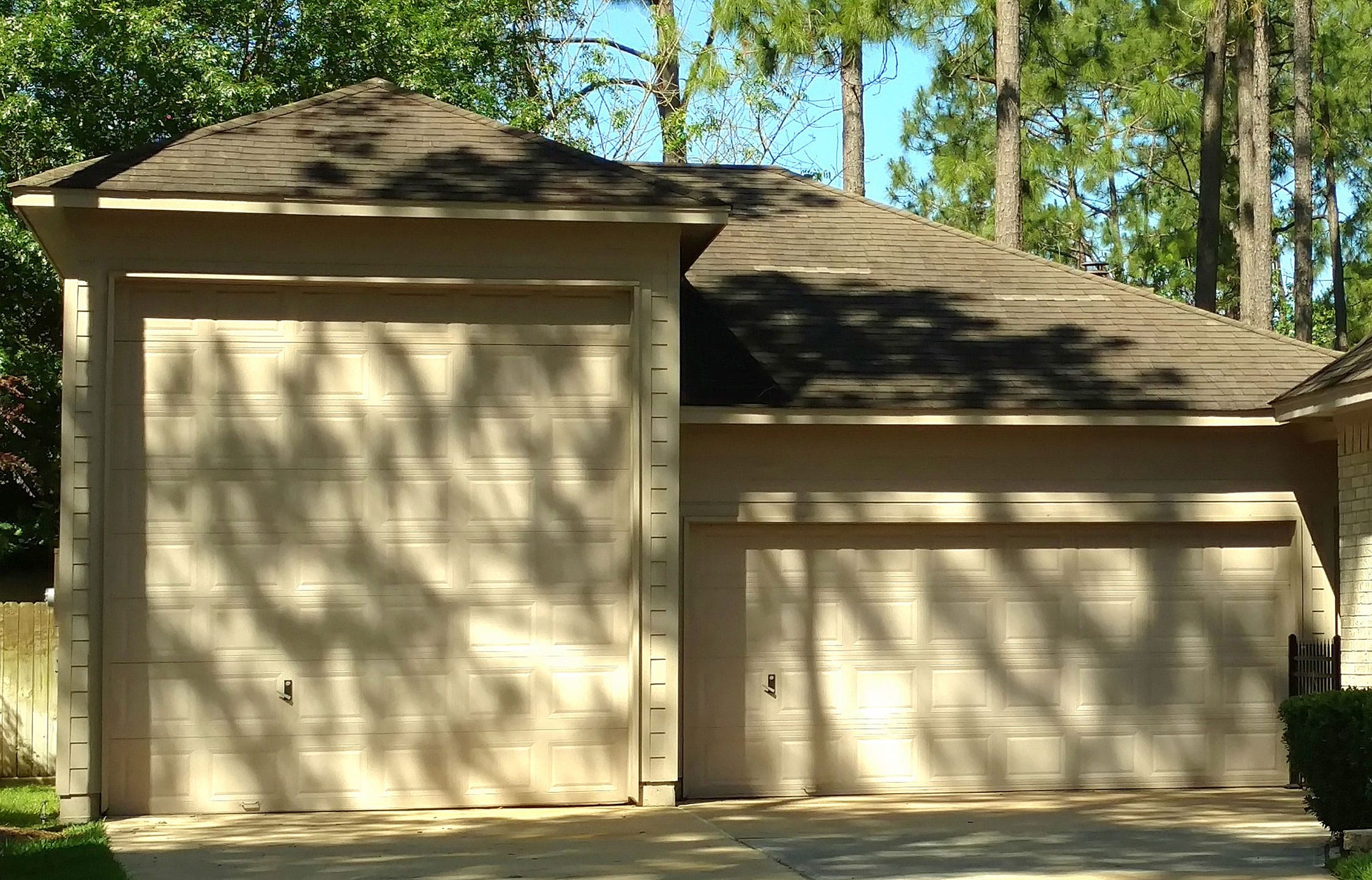
Oversized garage doors are commonly available 10 to 14 feet wide and 12 to 16 feet tall. Standard single garage doors, by comparison, are usually 8 to 10 feet wide and 7 to 8 feet tall.
- A door 10 to 14 feet wide fits larger SUVs and trucks.
- A door 12 to 16 feet tall suits RVs, boats or anyone needing extra vertical space.
Custom sizes are also available if your needs don’t fit the typical dimensions.
How do durability and maintenance compare between materials?
Steel and aluminum are the most durable, lowest-maintenance materials for an oversized garage door, and wood needs the most care.
- Steel and aluminum doors are highly durable with minimal maintenance. Clean them occasionally and check for rust.
- Wood doors look beautiful but need regular sealing or painting to prevent warping or rotting.
- Fiberglass and vinyl doors resist dents and corrosion and need only occasional cleaning.
To keep any door in top shape, schedule regular maintenance: lubricating moving parts, checking the balance and inspecting the weatherstripping.
How can you lower the noise level of an oversized door?
You can lower the noise level of an oversized garage door with three things: an insulated door, a belt-driven opener and regular lubrication.
- Insulated doors are naturally quieter.
- Belt-driven openers run smoother and quieter than chain-driven ones.
- Lubricating the rollers and tracks on a regular schedule can cut noise noticeably.
If peace and quiet are a priority, ask your installer about noise-dampening options. To talk through sizes and prices for an oversized door in Raleigh, Durham, Cary or Fayetteville, call RJ Garage Door Service at (919) 438-7447 for a free estimate.