
Topics Covered:
Key takeaways
- A garage door spring is a heavy-duty coil that counterbalances the weight of the door so it can be opened by hand or by an automatic garage door opener.
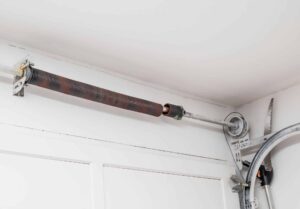
- Torsion springs mount on a metal shaft above the door and twist as it closes, while extension springs run parallel to the tracks on each side and stretch as the door moves.
- Clopay describes 10,000 cycles as the industry standard life for a torsion spring, and one cycle is one opening and one closing.
- Five signs a garage door spring needs changing are visible wear, a door that won’t stay open, a heavy or uneven door, a loud bang, and slow or jerky movement.
- Changing garage door springs is not a DIY project because of the high tension, precise adjustments and special tools such as winding bars.
A garage door spring is a heavy-duty coil that counterbalances the door’s weight, which makes the door easy to open and close, whether by hand or with an automatic garage door opener. Without springs, a garage door would be heavy and hard to lift. RJ Garage Door Service, a Raleigh garage door company serving Durham, Cary, Fayetteville and the Triangle since 2013, often gets questions from homeowners about garage door springs, one of the most important parts of the door.
Garage door springs come in two main types, torsion springs and extension springs:
- Torsion springs are mounted above the door on a metal shaft. A torsion spring twists as the door is lowered, storing energy that helps lift the door when you open it.
- Extension springs run parallel to the tracks on either side of the door. Extension springs stretch and contract as the door opens and closes, providing the force that lifts the door. They should have a safety cable running through them so a broken spring can’t fly loose.
Garage door springs wear out with use. Clopay describes 10,000 cycles as the industry standard life for a torsion spring, with 25,000-, 50,000- and 100,000-cycle springs available as upgrades. A door that opens and closes several times a day reaches 10,000 cycles years sooner than one used once a day, so busy households may want the longer-life springs.
Garage door springs are under a lot of tension, so they are dangerous to handle without the right knowledge and tools. Call a professional if your garage door springs need repair or replacement. In Raleigh’s varying climate, regular maintenance and inspections of your springs keep the door running smoothly and safely.
What are the signs your garage door springs need changing?
The signs your garage door springs need changing are visible wear, a door that won’t stay open, a heavy or uneven door, a loud bang and slow or jerky movement:
- Visible wear and tear shows up over time as rust, gaps in the coils or a visibly stretched spring. Any of these means the spring is nearing the end of its life.
- A door that doesn’t stay open, or falls when it is partly open, is a sign that the springs are weakening and no longer counterbalance the door.
- A heavy or uneven door, one that feels heavier than usual when you lift it by hand or rises with one side higher than the other, can mean a broken or weakened spring.
- A loud bang from your garage can mean a spring has broken. When a spring snaps, it releases a lot of energy at once, and the noise is hard to miss.
- Slower or jerky movement can come from a failing spring. The springs keep the door moving smoothly, so spring problems show up in how the door moves.
If you notice any of these signs, deal with the problem promptly. Running a garage door on faulty springs can damage the door and the opener, and it is a safety hazard. Contact an RJ Garage Door Service technician, who can safely inspect, repair or replace the springs. One thing you can safely do yourself is look: checking the springs for rust, gaps and stretching takes a minute and needs no tools.
Why is changing garage door springs not a DIY project?
Changing garage door springs is not a DIY project because of four problems: high tension, complex installation, specialized tools and other safety hazards. These are the reasons spring work is best left to professionals.
- High tension is the biggest danger. Garage door springs, especially torsion springs, are under heavy tension so they can counterbalance the door’s weight. A sudden release of that tension can cause serious injury if the spring snaps or isn’t secured properly during replacement.
- Complex installation is the second problem. Installing a garage door spring properly takes precise measurements and adjustments. An incorrectly installed spring can leave the door unbalanced, wear out other parts early, or stop the door from opening or closing properly.
- Specialized tools are required, such as winding bars for torsion springs. Using the wrong tools raises the risk of injury and of damage to the door.
- Other safety hazards come from the cables and brackets, which can also cause injuries if they are mishandled during the replacement. Improperly installed springs can also make the door fall suddenly or fail to stay open.
RJ Garage Door Service repairs and replaces garage door springs in the Raleigh area, with the tools to do the job safely. Contact RJ Garage Door Service or call (919) 438-7447 if you think your garage door springs are causing problems.