
Topics Covered:
Key takeaways
- Insulated aluminum garage doors averaged about $2,600 installed on RJ Garage Door Service’s 2025 Raleigh invoices, and wood-composite doors averaged about $3,200, a $600 premium.
- Wood-composite doors with polystyrene backing reach R-7 to R-8, while foam-filled aluminum doors reach about R-6.
- Wood-composite needs a fresh top coat about every five years; aluminum needs only washing and an annual wax.
- The Aluminum Association says recycled aluminum saves 95% of the energy needed to make new aluminum, while composite panels usually end up in landfill.
Aluminum is the better garage door for modern looks, recycling and minimal upkeep, and wood-composite is the better one for convincing woodgrain and slightly better insulation. Wood-composite is recycled wood fiber bonded with waterproof resin, usually over a polystyrene core.
RJ Garage Door Service drew this comparison from a decade of its own installations, service logs and thermal scans in Raleigh and the Triangle.
How do aluminum and wood-composite garage doors compare at a glance?
Aluminum and wood-composite garage doors compare on nine points:
| Category | Aluminum | Wood-Composite |
|---|---|---|
| Impact resistance | Dents on hard blows | Rigid; may chip on sharp impact |
| Panel weight (16 x 7 ft) | About 115 lb | About 135 lb |
| Typical R-value | R-6 (foam-filled) | R-7 to R-8 (foam-backed) |
| Moisture/rot risk | None | Low; edges must stay sealed |
| Maintenance | Quarterly rinse; annual wax | Paint touch-up every 5 yrs |
| Installed price* | $2.6k (avg.) | $3.2k (avg.) |
| Recyclability | Infinite alloy loop | Difficult; mixed material |
| Hardware needs | Std. torsion + 1/2 HP opener | Std. torsion + 1/2 HP opener |
| Warranty typical | 20 yrs finish/frame | 15 yrs delam/rot |
*Installed prices are RJ Garage Door Service’s average Raleigh-area pricing for 2025, including removal of the old door and a standard opener hookup.
Which handles everyday bumps better, aluminum or composite?
Wood-composite handles everyday bumps a little better than aluminum, and its damage is easier to fix. Aluminum skins (0.040 to 0.060 in.) resist casual bumps but crease when a basketball or ladder hits squarely, and the dent stays unless someone pulls it with suction tools. A sharp metal edge can chip composite.
In RJ Garage Door Service’s shop test, a six-pound medicine ball dropped on each door left a shallow dent in aluminum and a coin-sized bruise in composite that sanded smooth and took new paint in under an hour. If you’re comfortable with wood filler and paint, composite is the easier door to repair yourself.
Which stands up better to moisture and weather?
Aluminum stands up better to moisture, because it never rusts and its oxide film protects scratches. Wood-composite resists rot far better than solid wood, since resin fills the cell walls and keeps fungus out, but exposed edges still wick water if the factory primer chips.
Run a bead of sealant along composite panel seams once a year to stop swelling. On the coast both materials survive salt spray, but composite owners should rinse the bottom of the door monthly to flush sand out of the trim joints.
Which insulates better and lowers energy bills?
Wood-composite insulates better than aluminum, at R-7 to R-8 from polystyrene sheets behind the fiber shell, against about R-6 for aluminum with polyurethane foam and thermal breaks in the rails. In RJ Garage Door Service’s July FLIR scans of conditioned Raleigh garages, composite interiors ran 3 to 4 degrees F cooler than aluminum under direct sun. You’d notice that in a home gym or workshop; in an unconditioned garage, it won’t show up on your bill.
Does the weight difference affect springs or the opener?
The 20-lb weight difference between aluminum (about 115 lb) and wood-composite (about 135 lb) affects springs only slightly. Both doors stay within a 1/2 HP opener’s limits. RJ Garage Door Service’s maintenance logs show composite doors needing spring rebalancing somewhat sooner over ten years.
Aluminum starts and stops with a bit less vibration, which helps with a bonus room over the garage. Nylon rollers bring either door down to about the noise of the HVAC.
How much maintenance does each door need?
An aluminum door needs a hose rinse, a mild soap wash and a coat of wax once a year to delay powder-coat chalking, plus touch-up pen on scratches that expose bare alloy. A wood-composite door needs the same washing plus a fresh top coat about every five years to keep the grain crisp and block UV. Skip the repaint and the resin binder chalks into a mottled fade.
Which looks better on your house?
Aluminum looks better on modern houses, and wood-composite looks better where you want a wood look. Aluminum suits flush matte panels, anodized champagne tints and full-view glass hybrids, with powder-coat colors from bold red to graphite black and no risk of warping.
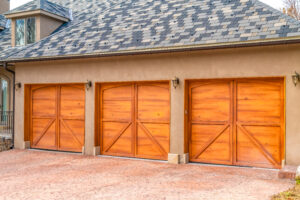
Composite’s strength is realistic woodgrain: walnut cathedral panels, reclaimed-barn saw marks or vertical-slat faux cedar that fools people at the curb. If your HOA wants a wood look, composite gets it without yearly staining.
Which is better for the environment?
Aluminum is better for recycling, and composite is better at reusing waste wood. Aluminum is endlessly recyclable, and the Aluminum Association says recycled aluminum saves 95% of the energy needed to make new aluminum.
Composite puts sawdust that would go to landfill to use, but thermoset resin locks the fibers into panels that can’t be separated, so most composite doors end up in landfill.
How much do aluminum and composite doors cost, and which pays back at resale?
An insulated aluminum door costs about $2,600 installed and a wood-composite door about $3,200, according to RJ Garage Door Service’s 2025 Raleigh invoices.
The 2025 Cost vs. Value Report from Zonda Media, as reported by DASMA, ranked garage door replacement first of 28 projects nationally, with a $4,672 average cost and a $12,507 estimated resale value; the report doesn’t compare materials. Buyers tend to see composite as wood without the upkeep, which helps justify its $600 premium.
Should you choose aluminum or wood-composite?
Choose aluminum if you want rust immunity, lighter hardware, bold contemporary colors and the least upkeep.
Choose wood-composite if realistic grain and slightly better insulation are worth repainting every five years and a modest price bump.
Whichever you pick, RJ Garage Door Service technicians size the springs, calibrate the opener force and seal the weatherstripping so the door runs smoothly for years. Call (919) 438-7447 for a free estimate.